
Communication Through Place and Time
This list brings together places where communication played an essential role, whether through signals, written records, spoken agreements, or collective memory. Each site reflects existing Parks Canada interpretation and invites visitors to think about how messages shaped everyday life, relationships, and communities across Canada.
Places
Signal Hill National Historic Site
St. John's, Newfoundland and Labrador
For centuries, Signal Hill was a place where watching and signalling mattered. The Noonday gun was used to keep time and also served as a cue to ships on foggy days. From flag signals used to identify ships entering St. John’s harbour, to the moment in 1901 when the first transatlantic wireless signal was received here, Signal Hill tells a story of communication that connects local life to global history.
HMCS Haida National Historic Site
Hamilton, Ontario
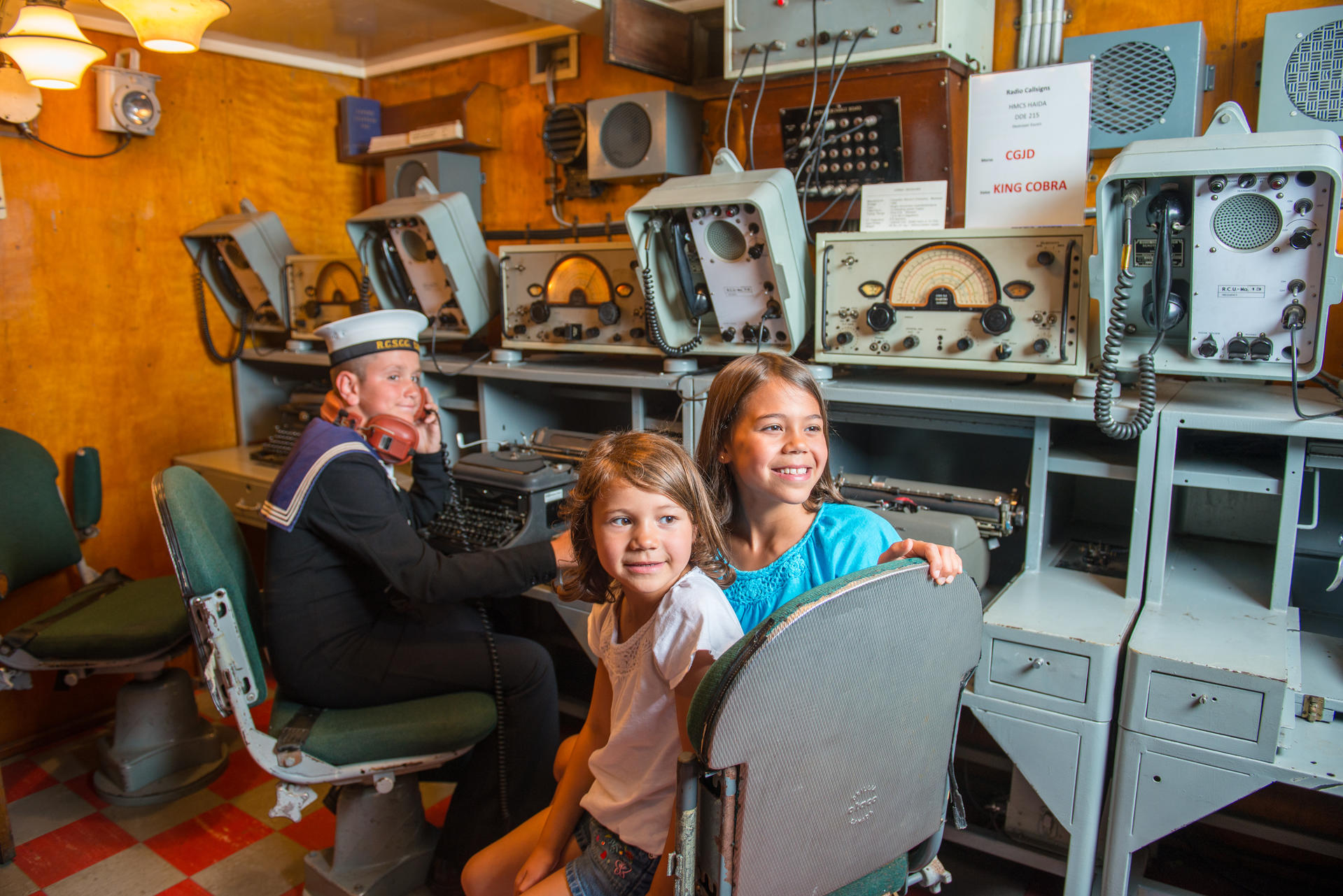
A visit to HMCS Haida – Canada’s “fightingest ship” – reveals how communication was essential at sea. Signal flags, radio rooms, radar, and sonar all worked together to help the ship navigate, coordinate with other vessels, and operate during wartime. Throughout the ship, Parks Canada and Friends of HMCS Haida interpretation highlights how crew members relied on these critical systems every day.
Halifax Citadel National Historic Site
Halifax, Nova Scotia
High above Halifax Harbour, the Citadel was a place where messages and orders shaped daily life. Signals helped coordinate defence, while the Noon Gun acted as a time signal for ships and the city below. Today, visitors can explore how communication supported military routines and a growing port city.
Grosse Île and the Irish Memorial National Historic Site
Saint-Antoine-de-l'Isle-aux-Grues
At Grosse Île, communication was at the heart of the operations of the quarantine station and of an immigrant’s journey. Ships arriving at the Port of Québec were inspected, medical information recorded, and flags used to signal health conditions. This place tells the story of how communication, health information, and immigration were closely linked for generations of newcomers.
Lower Fort Garry National Historic Site
St. Andrews, MB
Lower Fort Garry was a centre of exchange, not only of goods, but of ideas, agreements, and decisions. Communication took place through written correspondence, oral negotiation, and diplomacy. The site is also where Treaty No. 1 was signed in 1871, highlighting the lasting importance of dialogue and communication between Indigenous nations and the Crown.
History will unfold before your eyes at this restored 19th-century fort, where skilled costumed interpreters evoke the spirit of the past on this Red River Settlement.
Step into a microcosm of Canadian history, follow a costumed guide, and hear tales of the fort’s inhabitants who helped shape this historic stronghold and the vision of Western Canada.
Take a walk down to Gabeshiwin and explore the birchbark wigwam and buffalo hide tipi. Make sure you don’t miss out on the historic weapons demonstration! Interpreters will walk you through the process of assembling historic firearms before demonstrating their use outside the walls of the fort.
Batoche National Historic Site
Batoche, Saskatchewan
Batoche is a place where voices matter deeply. During the Métis Resistance of 1885, people communicated through petitions, letters, proclamations, newspapers, and oral networks. Today, Parks Canada interpretation presents Batoche as a place where messages, perspectives, and memories continue to shape understanding of the past.
York Factory National Historic Site
York Factory, Manitoba
Once a major administrative and supply centre for the Hudson’s Bay Company, York Factory connected far‑reaching trade and communication networks. Letters, records, and schedules passed through this remote location, linking Indigenous trading routes with global markets and decision‑making far beyond the region.
Manitoba’s rivers served as York Factory’s most crucial communication network, transporting product and people by York boat between settlements.
Only two buildings, two visible ruins, a cemetery, vestigial remnants of planned landscapes and extensive archaeological remains exist today of what was once a large complex.
A remote piece of Canadian history, visitors to the site must arrive by helicopter, boat, canoe or kayak to experience the wealth of relics and stories found on the shore of the Hayes River.
Alexander Graham Bell National Historic Site
Baddeck, Nova Scotia
This site celebrates the lives and work of Alexander Graham Bell and Mabel Hubbard Bell, whose partnership helped inspire new ways of connecting people. Influenced in part by Mabel’s experience as a deaf woman, Bell pursued a lifelong interest in sound, speech, and communication. Best known for inventing the telephone, he also experimented with recording technologies, wireless transmission, and other innovations at his Baddeck laboratory. Parks Canada interpretation highlights their shared legacy of curiosity, creativity, and breaking down barriers to communication. Visitors can also experience the site’s popular White Glove Tour, which offers a rare behind-the-scenes look at personal artifacts connected to Alexander and Mabel Bell.
Road Map
St. John's, Newfoundland and Labrador to Baddeck, Nova Scotia
Popular VisitLists
Discover Niagara’s Early Settlers
Grimsby, Ontario to St. Catharines, Ontario 7 places
Take a trip back in time and explore the stories of Niagara’s early settlers.
View VisitList
Discover your inner viking
Gimli, Manitoba 1 place
We tell the story of the settlement of the New Iceland !
View VisitList
Built Heritage
Annapolis Royal, Nova Scotia to Middleton, Nova Scotia 5 places
Built heritage in Annapolis Royal, Bridgetown, and Middleton, Nova Scotia.
View VisitList
The Golden Era: BC Electric Railway’s Interurban Trams and Street Cars
Surrey, British Columbia to North Vancouver, British Columbia 4 places
Discover the stories of interurban trams and street cars that shaped BC’s Lower Mainland.
View VisitList


